
Where I Would Take Pilates in Toronto: A Pilates Teacher's Guide to Really Good Studios
Toronto has more Pilates studios than ever before. And while having more choice should make it easier to find a great class, in some ways, it has made it harder.
Beautiful new studios are opening all over the city. There are gorgeous interiors, custom reformers, great playlists, beautiful branding and very impressive Instagram feeds.
And to be clear: there is absolutely nothing wrong with any of those things. I love a beautiful studio.
But a beautiful Pilates studio and an excellent Pilates studio aren't necessarily the same thing.
I've been teaching movement for more than 25 years and have owned Mindful Movement Centre in Toronto since 2008. I've watched Pilates evolve from something relatively few people knew much about into one of the most popular forms of movement in the city.
For the most part, I think that's wonderful.
But the explosion of Pilates has also made it harder for the average person to know what they're actually getting.
So this isn't a list of Toronto's trendiest Pilates studios. It isn't a ranking of the studios with the biggest social followings or the most beautiful spaces. And, although my own studio is included, it certainly isn't an argument that we're the only place doing Pilates well.
Instead, I thought I'd share something a little more personal:
If I were going to take a Pilates class somewhere else in Toronto, where would I go?
Some of my choices have been part of Toronto's Pilates community for decades. Others are quite new. Some are contemporary, some more traditional. Some are tiny, some are larger.
What they have in common is that I respect the movement experience they're creating and the people behind it.
But first, it helps to understand what I'm looking for.
What Actually Makes a Great Pilates Studio?
When you're scrolling through studio websites, it can be difficult to tell the difference between a great Pilates studio and a pretty good - or simply pretty -one.
Here's what matters to me.
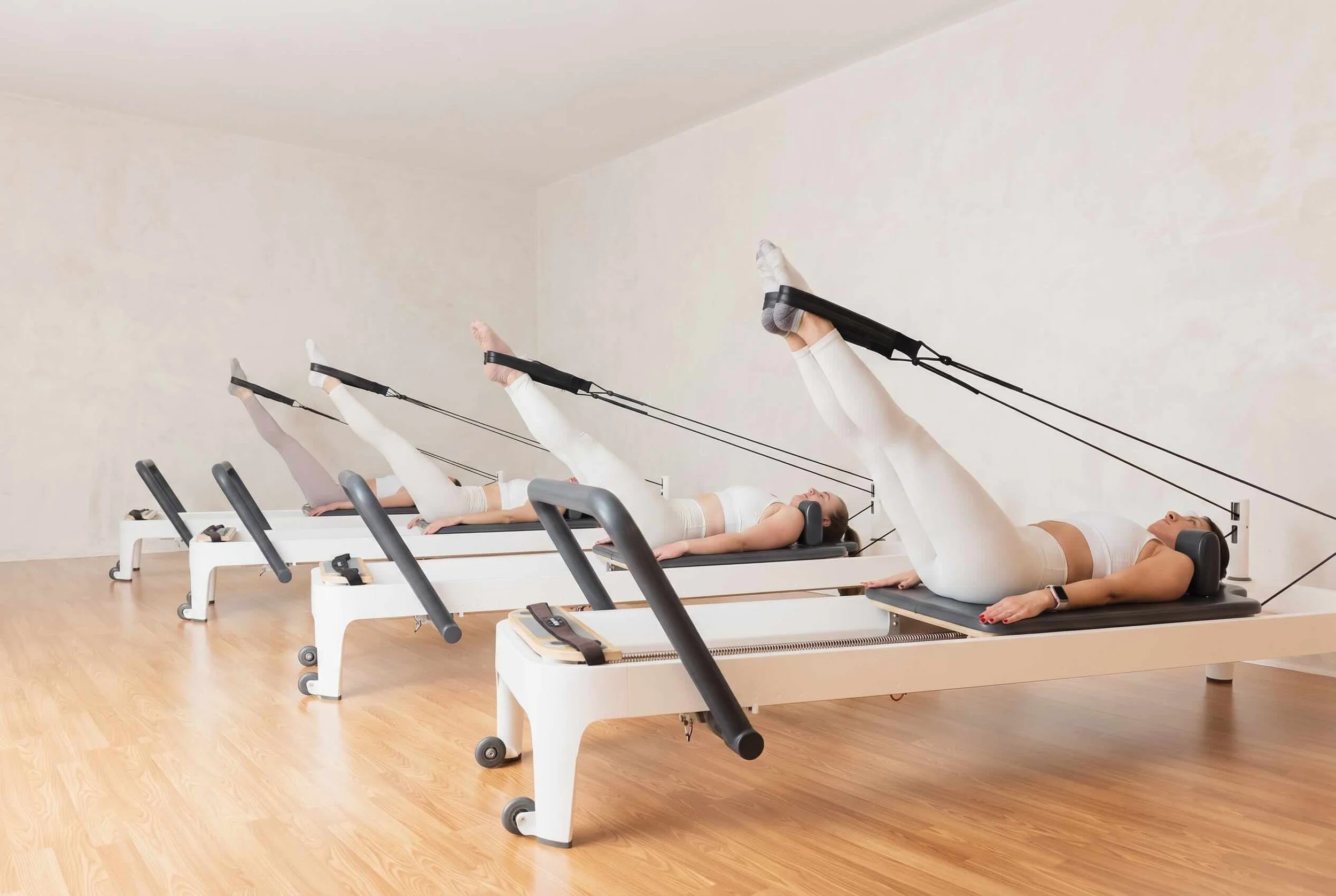
1. Class size….and the amount of attention you receive
This is a big one for me.
Pilates is not simply choreography performed on a reformer. Your teacher should be watching you move.
They should be able to notice when you're compensating, help you find a better position, offer a modification when something isn't right for your body, change the challenge when you're ready for more and, ideally, help you understand why you're doing what you're doing.
Personally, I prefer smaller classes because they give an instructor more opportunity to do that.
In my experience, once you get much beyond 10 reformers with one instructor, it becomes extraordinarily difficult for even a very good teacher to truly observe every person in the room.
That doesn't mean a studio with ten reformers cares less than one with six. And class size certainly isn't the only measure of good teaching. An exceptional instructor can manage a room beautifully, while a small class isn't automatically a good one simply because it's small.
It's really about access to the teacher.
Can they see you? Do they notice you? Can they respond to what's happening in the room rather than simply delivering choreography?
That's what I'm looking for.
2. Teachers who are educated…..and keep learning
Great Pilates teaching requires more than completing a certification.
The best studios hire carefully and create a culture where teachers continue learning throughout their careers - through experience, collaboration, continuing education and simply spending years watching different bodies move.
Experience matters enormously.
A teacher who has spent years working with different bodies develops an eye that can't be learned from a manual alone.
And that ability to really see the person in front of you is one of the things that separates an excellent Pilates teacher from someone who simply knows a repertoire of exercises.
3. Teaching, rather than performing
Watch the instructor.
Are they watching their clients - or are they doing the workout at the front of the room?
A good Pilates teacher doesn't need to perform every exercise and repetition with you. They need to be looking at you.
Pilates teaching is observational. It requires the instructor to see what is happening, interpret it and decide what cue, correction, progression or modification might help.
4. Thoughtful programming
More complicated does not necessarily mean more advanced.
And harder does not necessarily mean better.
Good Pilates programming has a reason behind it. Exercises build on one another. Beginners learn foundations. More experienced clients are given appropriate progressions. Challenge comes from precision, control, load, coordination and complexity - not simply from trying to make every exercise as difficult as possible.
A great teacher should be able to tell you why you're doing something.
5. A real understanding of the Pilates method
The reformer is an extraordinary piece of equipment.
But putting a fitness class on a reformer doesn't automatically make that class Pilates.
There is certainly room for contemporary interpretation (and I am very much a contemporary teacher myself) but underneath the creativity should be an understanding of the Pilates system, movement principles, anatomy, progression and purpose.
The best teachers know the method well enough to evolve it thoughtfully.
6. A studio that invests in the experience—not just the aesthetic
This might be my favourite test.
Beautiful design is lovely. Good lighting is lovely. Nice bathrooms are lovely. I am all for making a studio somewhere people want to spend time.
But I also want to know what has been invested in the actual movement experience.
Who are the teachers? What do they know? Are they continuing to learn? Is the programming thoughtful? Are clients being seen? Does the studio have a clear philosophy behind what it teaches?
Because ultimately, your body doesn't know how beautiful the room is.
It knows the quality of the movement experience you received.
7. And finally...heart
Looking at the studios on this list, I realized they have something else in common: they're all relatively small, independent and community-oriented.
That matters to me.
I love studios where the people behind the business are genuinely connected to the work - where they know their teachers, know their clients and care deeply about the experience they're creating.
There are plenty of larger Pilates brands offering a very different experience, and that may be exactly what some people are looking for. But personally, I gravitate toward independent studios with a little more heart.
Pilates has always been personal to me. I want the place I practise it to feel that way too.
The Toronto Pilates Studios Where I Would Take a Class
This is deliberately not a ranking, and it isn't meant to be an exhaustive list of every good Pilates studio in Toronto.
These are simply some of the other studios in the city where I would personally take a class. (when I have time to get to another studio! 😂)
After more than 25 years teaching movement, and nearly two decades owning a Pilates studio, I have a pretty good sense of what I value when I walk into a movement space.
I want knowledgeable teachers. I want thoughtful programming. I want instructors who are actually watching the people they're teaching. I want a studio that understands the Pilates method, while still allowing its teachers to be curious and contemporary in how they use it.
Small classes are something I personally value, too. More individual attention is one of the great benefits of Pilates, and smaller groups naturally give a teacher more opportunity to observe each person. But class size alone doesn't tell you whether a studio, or a teacher, is excellent.
These are studios I respect for different reasons. Some have been around for decades; others are relatively new. Some are more traditional, some more contemporary. Some are tiny, some are larger.
What they have in common is that I'd be happy to walk through the door, get on a Reformer (or a Cadillac, Chair, Tower or Mat!) and let one of their teachers teach me.
Mindful Movement Centre - Yorkville
I'll start with the one I obviously know best.
I founded Mindful Movement Centre in Yorkville in 2008, and nearly two decades later, the philosophy behind what we do hasn't really changed: we want people to move better, understand their bodies and feel genuinely cared for while they're here.
Our equipment classes are intentionally small, and capped at nine people. We offer Reformer, Tower and Mat + Tower classes alongside private Pilates, and we work with an enormous range of bodies, ages, movement histories and goals.
Education is also a huge part of who we are. We train Pilates teachers ourselves, and our team continues to study movement, anatomy, injuries, special populations and the art of teaching throughout their careers.
But perhaps the thing I'm proudest of is that MMC doesn't feel like a workout factory.
We know our clients. We know their bodies. We notice when something changes. And we want someone to leave class knowing a little more about themselves than they did when they arrived.
That's what Pilates has always meant to me.
Inhabit Pilates & Movement - Christie/Dupont
Inhabit offers a wonderfully individualized approach to Pilates, with clients able to work with personalized programming and across the wider Pilates apparatus - not simply the Reformer.
I love that their model gives teachers the opportunity to really work with the person in front of them. For anyone looking for a highly personalized Pilates experience, Inhabit is absolutely worth knowing.
Muse Movement - Queen West
Muse feels contemporary, warm and community-focused, while still taking the craft of teaching seriously.
And a fun bit of MMC history: founder Keri O’Meara used to teach at Mindful Movement Centre, so I know firsthand the experience and care behind what she's created. Muse has a strong foundation in Pilates and functional movement, with a lovely combination of modern studio energy and genuinely good teaching.
Nice Day Pilates - Corktown
Nice Day feels fresh and contemporary, but there's real substance behind the beautiful space.
Founder Jen Winter is a brilliant instructor herself and has been part of the Pilates world for well over a decade. She has a fantastic eye for movement, and that depth of experience is reflected in the intelligent, considered approach at Nice Day.
Reunion Yoga & Pilates - Bloorcourt Village
Reunion has a warmth and authenticity that I really love.
Owners Scotty Mac and Erick Stewart care deeply about what they do, and that comes through in the community they've built and the experience they've created. It feels welcoming, grounded and unpretentious - a place that's genuinely about good movement and the people who come through the door.
Nicole Piller Pilates & Yoga Studio - Coxwell/Danforth
Nicole is a friend of mine, an exceptionally knowledgeable teacher - ad has been in the Pilates world even longer than me! Her understanding extends well beyond the Pilates repertoire into anatomy, biomechanics and a wide range of movement modalities.
She brings all of that knowledge into highly individualized, thoughtful work with her clients. Nicole is someone whose expertise I trust - and a teacher I'd very happily take a class or private session with myself.
Corso Movement - St. Clair West
Corso is newer to Toronto's Pilates landscape, but what I appreciate is the intention behind it.
Its owner is actually taking MMC's Pilates Teacher Training this year, because she genuinely wants to understand the method behind the business she's building. That curiosity and commitment to learning is something I really respect - and it shows in the thought being put into the movement experience at Corso.
Atelier Pilates by Tmotion - Annex
Atelier may be a newer studio, but its owner certainly isn't new to Toronto Pilates.
Tmotion has been part of the city's movement community for years, and you can feel that experience behind what's being created at Atelier. It's a beautiful space, but more importantly, there's knowledge and a genuine understanding of Pilates behind it.
Pilates Process - Danforth
Pilates Process has a depth of knowledge and a therapeutic approach to movement that I really respect.
Their work is highly individualized and grounded in understanding the person in front of them - particularly valuable for anyone with injuries or a more complex movement history. It's detailed, anatomy-informed Pilates from people who really know what they're doing.

Pretty Pilates Isn't the Problem
I want to be really clear about this.
Pretty Pilates is not the enemy.
Some of the studios on this list are absolutely beautiful. I have also spent plenty of time and money making Mindful Movement Centre a space that feels lovely to walk into.
Environment matters.
Community matters.
Music (or quiet) matters.
Feeling excited to go to your Pilates class matters.
The problem is when those things become substitutes for good teaching rather than additions to it.
There is also nothing inherently wrong with wanting a high-energy reformer workout rather than a traditional Pilates experience. If you love a dark room, loud music, fast transitions and an instructor who makes you sweat for 50 minutes, wonderful.
Movement you enjoy is valuable.
I simply think consumers should know what they're buying.
A reformer-based fitness class and a deeply taught Pilates class can both be great experiences.
They just aren't necessarily the same experience.
How to Tell if Your Pilates Studio Is Actually Good
You don't need to know the Pilates repertoire or understand anatomy to recognize good teaching.
Pay attention to what happens in the room.
Does the teacher know your name?
Do they look at you when you're moving?
Do they notice when something isn't working?
Do they offer modifications that feel purposeful rather than simply easier?
Can they explain why you're doing an exercise?
Does the class feel appropriate for the level advertised?
Are beginners actually taught how to use the equipment?
Does the teacher seem curious?
Do they continue learning?
Does the studio seem to care about the quality of the movement experience - not simply how it photographs?
And perhaps most importantly:
Do you leave understanding your body a little better than when you arrived?
That, to me, is one of the greatest gifts Pilates can give you.
Why I Still Prefer Smaller Pilates Classes
Pilates is expensive. There's no getting around that.
Equipment is expensive. Toronto rent is expensive. Excellent teachers deserve to be paid properly.
So when comparing prices, I would encourage you not to look only at the cost of a single class.
Consider the experience you're actually paying for.
Personally, one of the things I value most is access to the teacher. I want them to be able to see my movement, recognize when something needs to change and actually teach me….not simply give me a sequence to follow.
Smaller classes naturally make that easier.
That doesn't mean every small class is excellent, or that a slightly larger class can't be taught beautifully.
But there is a point at which one teacher simply can't give meaningful individual attention to everyone in the room.
You're not simply renting a reformer for 50 minutes.
You're paying for someone's expertise.
You're paying for their eyes on your movement.
You're paying for their ability to recognize when something needs to change.
You're paying for teaching.
For me, that is where much of the value of Pilates lives.
So, Which Toronto Pilates Studio Should You Choose?
The answer is probably not the same for everyone.
Location matters. Schedule matters. Budget matters. The kind of environment you enjoy matters. And sometimes you simply connect with one teacher in a way you don't with another.
Try a few studios.
Take advantage of introductory offers. Try different teachers. Notice how you feel - not just physically after class, but during it.
And don't be afraid to ask questions.
Ask about class sizes.
Ask about your teacher's experience and education.
Ask whether teachers continue learning.
Ask what kind of Pilates the studio teaches.
A good studio should be happy that you care.
And if you can't take a class at Mindful Movement Centre, or we're simply not your particular Pilates home, these are some of the places in Toronto where I'd be very happy to take one myself.
Toronto has some extraordinary Pilates teachers.
The trick is knowing what to look for.
And once you do, the difference between doing exercises on a reformer and being taught Pilates becomes very easy to feel.
Leslie xoxo